Tuesday, November 4, 2014
Financing the transition to a green economy: Where’s the money?
According to the United Nations Intergovernmental Panel on Climate Change,
the Earth is set to warm by 4 to 5 degrees compared with pre-industrial
levels, warming that will wreak devastating effects on the planet and
lead to massive destruction, loss of life and loss of subsistence for
millions. In order to avoid this outcome, the International Energy Agency says we need US$1trn a year until 2050 to finance a transition to green growth and green lifestyles.
Where is this US$1trn going to come from?
First, based on research by the Climate Policy Initiative, three-quarters of all climate financing already comes from the country it is spent in. We will need (and will have to get) funding from most countries, even very poor ones, though that’s not the same thing as saying we need it from their public purse: climate change is a global “commons” and requires every individual, company, and country to participate in its solution.
Sunday, November 2, 2014
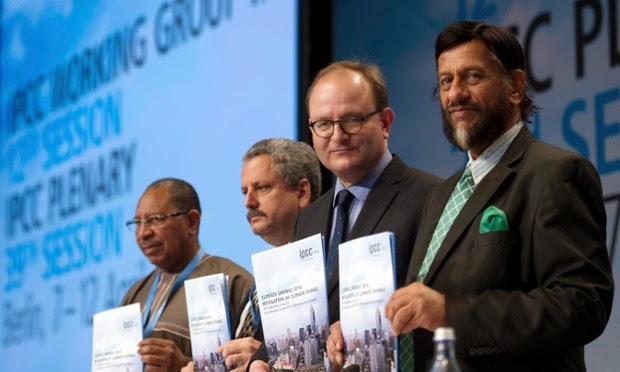
Climate change raises issues of equity, justice and fairness, IPCC affirms
The Synthesis Report released by the Intergovernmental Panel on Climate Change (IPCC) on Sunday, November 2, 2014 has affirmed that limiting the effects of climate change raises issues of equity, justice,
and fairness and it is increasingly becoming necessary to achieve sustainable development and
poverty eradication.
The Synthesis Report makes a clear case that many risks constitute
particular challenges for the least developed countries and vulnerable
communities, given their limited ability to cope. People who are
socially, economically, culturally, politically, institutionally, or
otherwise marginalized are especially vulnerable to climate change.
“Many of those most vulnerable to climate change have contributed and
contribute little to greenhouse gas emissions,” Pachauri said.
“Addressing climate change will not be possible if individual agents
advance their own interests independently; it can only be achieved
through cooperative responses, including international cooperation.”
From Marrakech to Bulawayo, African CSOs confront climate change
| Cross-Section of African CSO Leaders at Launch of PACJA Morocco |
It took twenty-two (22) days in the month of October
2014 to complete the race of about 70707km from Morocco to Zimbabwe.
What is at stake here, the Olympics, the
World Cup, Africa Cup of Nations torch or the visit
of King Mohamed VI to President Mugabe? You be the Judge!
If East Africa was involved in this race, you
can guess they will lift the gold medal but it was between the north and south
so it can't be it.
Well, this was the distance covered by the Morocco
Network on Climate Change (MNCC) at Marrakech on October 7, 2014 and Zimbabwe
Climate Change Coalition (ZCCC) on October 29, 2014 when the two national
chapters of PACJA were launched respectively.
What did the two nations have in common besides
been African countries- THE CHALLENGE OF
CLIMATE CHANGE!
"We are holding your German Hostage," Shekau boasts in a new video
![]() |
| Abubakar Shekau |
Boko Haram has claimed in a new video obtained by AFP that a German national is in their custody. Leader of the terrorist group, Abubakar Shekau's boast that "we holding your German hostage," makes it the first claim of
responsibility for the abduction, which happened on July 16.
The German foreign ministry in Berlin said it did not want to comment when contacted by AFP.
Armed
gunmen kidnapped the foreigner, who was said to be a teacher at a
government technical training centre in Gombi, about 100 kilometres (62
miles) from the Adamawa state capital Yola.
Suspicion
immediately fell on Boko Haram, which has repeatedly attacked schools
teaching a so-called Western curriculum, as well as teachers and
students. An offshoot of Boko Haram,
Ansaru, has previously claimed the kidnapping of at least eight
foreigners in northern Nigeria since 2012 but the group has been largely
dormant for more than a year.
The
group reportedly broke with Boko Haram to specifically target
foreigners instead of Nigerians and executed seven expatriates it seized
from Bauchi state in 2013.
In
January 2012, Boko Haram kidnapped German engineer Edgar Raupach at a
construction site on the outskirts of the northern city of Kano. He was
killed during a military raid on a Boko Haram hideout on the outskirts
of the city four months later.
With emission cuts and adaptation, climate change effects can be limited, Says IPCC
Limiting climate change would require substantial and sustained reductions in greenhouse gas emissions which, together with adaptation, can limit climate change risks, a UN-backed expert panel says.
The Intergovernmental Panel on Climate Change (IPCC) reveals in a blunt report that continued emission of greenhouse gases will cause further warming and long-lasting changes in all components of the climate system, increasing the likelihood of severe, pervasive and irreversible impacts for people and ecosystems.
The IPCC's Synthesis Report was published on Sunday in Copenhagen, after a week of intense debate between scientists and government officials.
“Adaptation can play a key role in decreasing these risks,” said
Vicente Barros, Co-Chair of IPCC Working Group II. “Adaptation is so
important because it can be integrated with the pursuit of development,
and can help prepare for the risks to which we are already committed by
past emissions and existing infrastructure.”
But adaptation alone is not enough. Substantial and sustained
reductions of greenhouse gas emissions are at the core of limiting the
risks of climate change. And since mitigation reduces the rate as well
as the magnitude of warming, it also increases the time available for
adaptation to a particular level of climate change, potentially by
several decades.
Subscribe to:
Posts (Atom)